
Professor Kerstin Göpfrich

Talk: RNA Design - Folds for Future Generative Biology
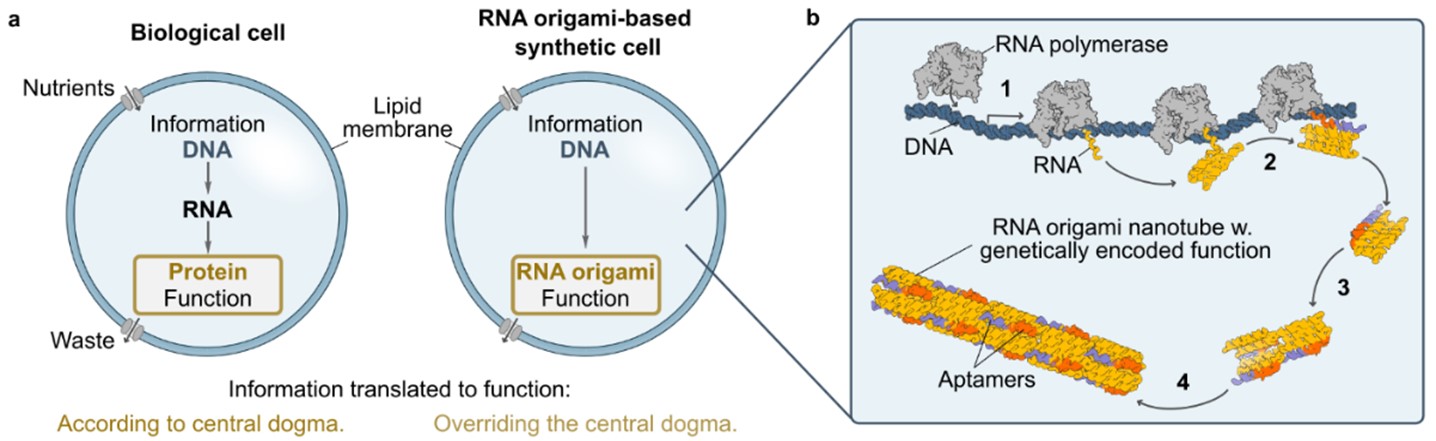
Today’s living cells emerge from the complex interplay of thousands of molecular constituents. Our vision is to create a simpler model of a cell that consists of a lipid vesicle and operates based on our own custom-engineered molecular hardware made from highly functional and folded RNA realised using co-transcriptional RNA origami.
Building on previous work with DNA nanotechnology, where we demonstrated DNA-based mimics of cytoskeletons, capable of cargo transport, force generation, and signal transduction, we now demonstrate that similar functions can be genetically encoded with RNA origami and expressed inside vesicles.
Beyond cytoskeletons, we demonstrate an all-RNA transmembrane pore, anchored in the lipid membrane with aptamers. We developed a high-throughput image-based screening technology based on photopolymerisation to select for highly functional variants of the initially rationally engineered synthetic cells.
Ultimately, by coupling vesicle division to their informational content and their function, we aim for a prototype of an RNA origami-based synthetic cell capable of evolution.
About this speaker
Kerstin Göpfrich is a German biophysicist and university professor working on RNA design and the bottom up construction of synthetic cells. Göpfrich's academic journey began at the University of Erlangen, where she earned a Bachelor of Science in Physics and studied Molecular Medicine.
She continued her studies in biophysics at the University of Cambridge, earning a PhD in 2017, with a focus on DNA origami nanopores as a Gates Cambridge Fellow. Göpfrich was a Marie Skłodowska-Curie Postdoctoral Fellow at the Max Planck Institute for Intelligent Systems in Stuttgart (2017-2019).
Since 2019, she has led the Max Planck Research Group Biophysical Engineering at the Max Planck Institute for Medical Research in Heidelberg. In November 2022, she was appointed a full professor at the Center for Molecular Biology of Heidelberg University. She is a Fellow of the Max Planck School "Matter to Life" and has served as the spokesperson for the newly established excellence cluster SynthImmune since 2025.
Kerstin’s work has been recognised with numerous awards, including the Alfried Krupp Prize (2024), the Allen Distinguished Investigator Award (2024), an ERC Starting Grant (2022), the Hector Research Career Development Award (2021), and the Women Interactive Materials Award (2021).
She is also dedicated to science communication, co-founding "Ring-a-Scientist" to engage with the public and bring science into classrooms.