
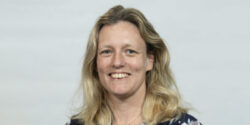
Professor Helen Walden
Talk: Understanding Parkin’s E3 ligase activity
Parkin is a RING-BetweenRING-RING (RBR) E3 ubiquitin ligase which is frequently mutated in early-onset Parkinson’s disease. One of the most studied roles of Parkin is in accelerating mitophagy. Upon induced mitochondrial damage, Parkin translocates to the outer mitochondrial membrane, is relieved from its autoinhibited state through activation mechanisms and ubiquitinates a myriad of substrates. Resulting ubiquitin chains on mitochondrial proteins are recognised by mitophagy effectors. The promiscuity of Parkin, which has been suggested to target hundreds of substrates, has remained a mystery, as it is unclear how this E3 ligase can recognise so many different proteins. We will present our recent work in which we focus on Parkin interaction with its preferred substrate, Miro1, and identify a substrate recognition site on Parkin. Our findings explain previously reported observations in cells involving Parkin and Miro1 in mitophagy.
About this speaker
Helen obtained her BSc in Biochemistry from the University of Bath in 1998. She then moved to the University of St Andrews for her PhD, investigating the structural basis of protein hyperthermostability.
In 2001, she moved to Memphis, Tennessee, for a postdoctoral position in the newly established lab of Brenda Schulman at St. Jude's Children's Research Hospital. It was here that Helen developed her interest in the mechanisms of ubiquitination, solving the structure of the E1 for Nedd8.
In 2005, Helen moved to the Lincoln's Inn Fields Laboratories of CRUK’s London Research Institute (now Francis Crick Institute), to establish her own group. After tenure, Helen moved to the MRC Phosphorylation and Ubiquitylation Unit at the University of Dundee from 2013, and in 2017 relocated her lab to the University of Glasgow as Professor of Structural Biology.
Helen was a member of the EMBO Young Investigator Programme from 2011 to 2014. She received the Colworth medal from the Biochemical Society in 2015, and an ERC Consolidator Award in 2016.